3rd segment (From 3h to 6h)
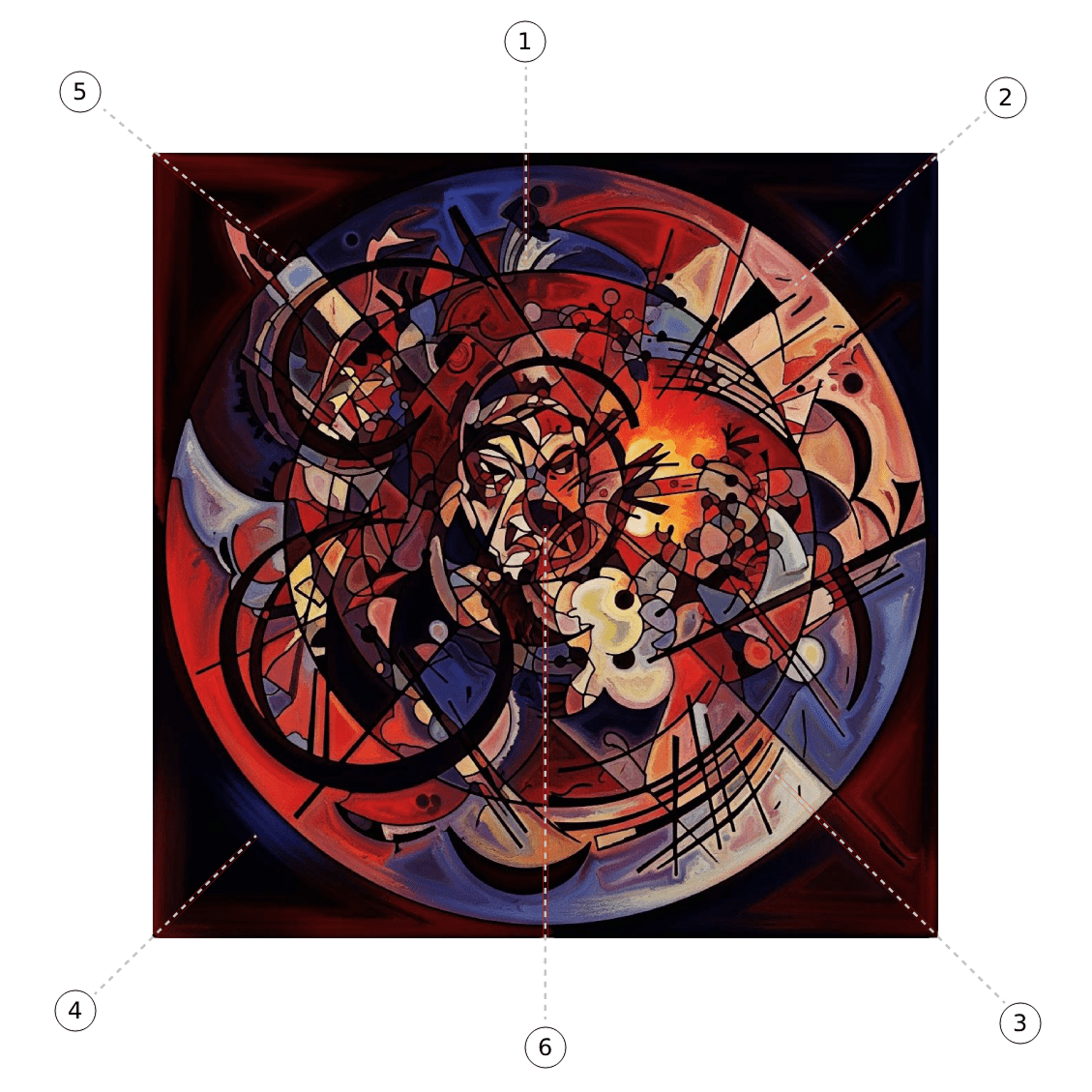
The third episode of the dial marks a pivotal transition: the irruption of the police figure and the establishment of an intellectual duel between the criminal and the examining magistrate, Porfiry Petrovich. In this phase, the composition abandons the tumult of fever to explore psychological pressure through a rigorous spatial organization inspired by Kandinsky’s research into the tension between center and periphery.
The geometry of encirclement: centers of gravity and containment
Where previous segments favored explosion, this portion of the dial witnesses the emergence of a more static structure, yet paradoxically one more charged with tension. The opposition between Raskolnikov and Porfiry is translated by concentric circles and closed forms.
For Kandinsky, the circle is the most balanced form; here, however, it signifies the tightening vise. The central point of this segment acts as a magnetic pole toward which invisible lines of force converge. The viewer perceives a sensation of confinement: space is no longer a place of flight but an arena where every graphic movement is immediately counterbalanced by an opposing force, illustrating the mental joust and the cat-and-mouse game.
Chromatic duality: the conflict of temperatures
The palette of this episode abandons the violence of red to focus on a dialectic between deep blues and acidic yellows. This choice follows a logic of thermal confrontation:
- Blue, associated by Kandinsky with depth and withdrawal (Porfiry’s analytical coldness), seeks to stabilize the composition.
- Yellow, the color of unease and latent madness (Raskolnikov’s agitation), strikes against this blue stability, creating zones of visual friction.
This dissonance between cold and warm colors does not seek harmony but underscores the incompatibility of the worlds in play. Yellow seems to want to escape the frame, while blue constrains it, visually materializing the interrogation and the impossibility for the guilty party to extricate himself from judicial logic.
Unstable balance: the weight of invisibility
One of the particularities of this segment lies in its use of emptiness. Space is not saturated; it contains zones of neutral grey that act as silences heavy with meaning. These areas of apparent rest are merely pauses in the symphony of chaos—moments of suspension where truth threatens to emerge between two forms.
In sum, this third point of the dial proposes an architecture of suspicion. Through a subtle interplay of heavy masses and resisting lines, the work succeeds in conveying a war of psychological attrition. Movement no longer resides in the stroke, but in the invisible tension binding elements together, transforming the painted surface into a field of moral forces.