6th segment (Center of the cercle)
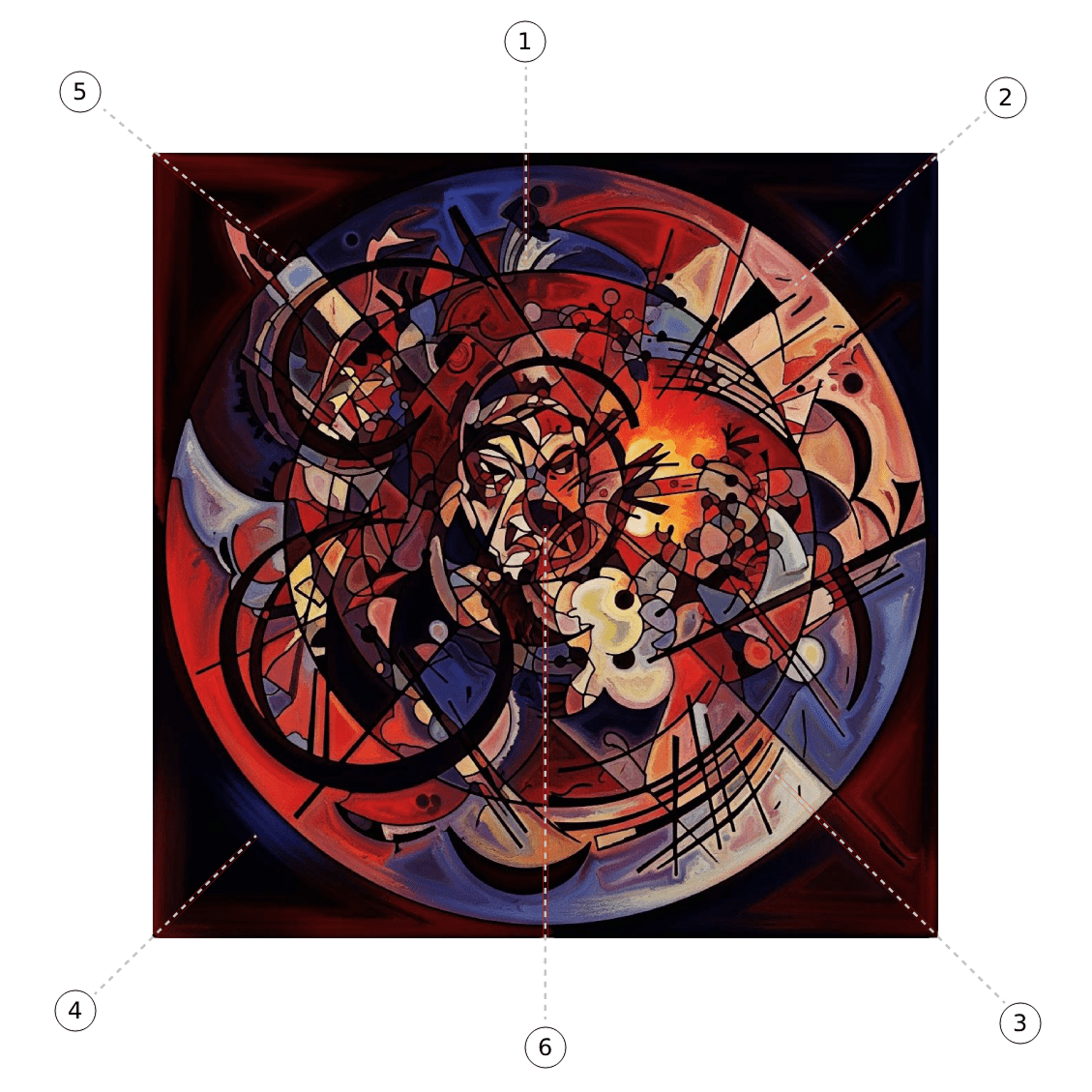
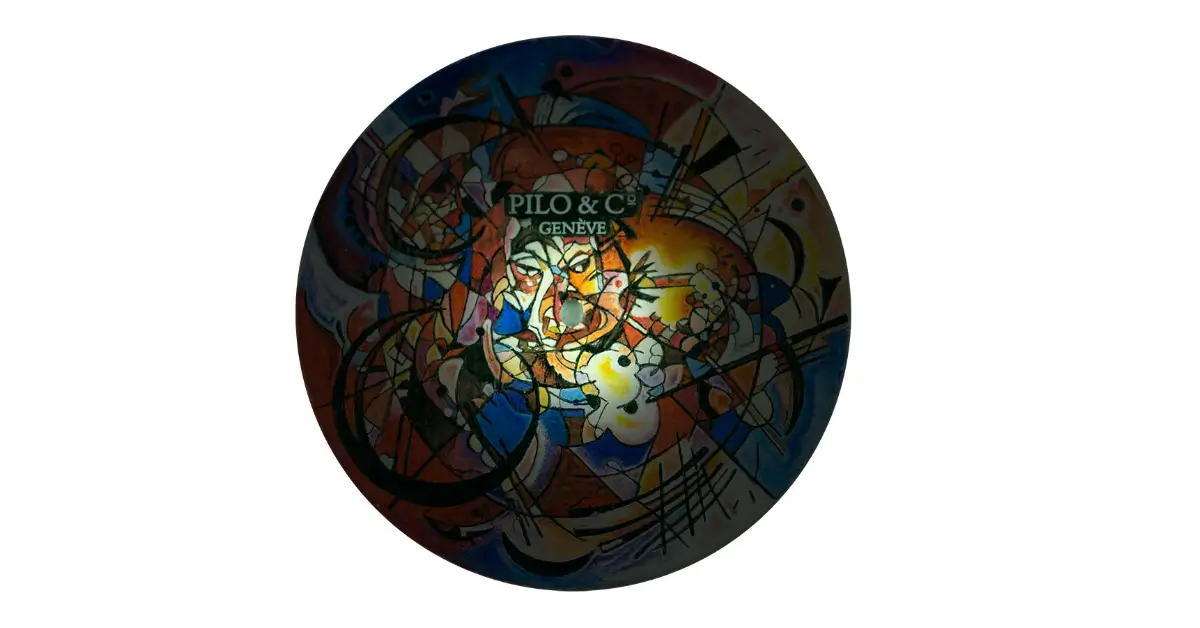
The sixth point of the dial, situated at the heart of the watch, constitutes the culmination of the spiritual journey. After peripheral turmoil, the composition converges toward a zone of resolution. This center marks not merely the end of a narrative, but the birth of a new formal order, inspired by Kandinsky’s periods in which rigid geometry gives way to luminous organic fluidity.
The revolution of forms: from vector to radiant circle
Where previous segments were governed by conflicting forces and broken lines, the center is dominated by the prevalence of curve and circle. For Kandinsky, the circle is the form that unites the greatest number of opposing tensions in perfect equilibrium.
Here, forms are soft, fluid, and seem to radiate outward from the central point. This centrifugal structure suggests that redemption is not a static end, but a dissusive energy. Contours are no longer borders or enclosures (as in the paranoia segment), but permeable membranes fostering interconnection. “Inner necessity” finally finds its expression in harmony.
Transfigured light: the chromatic apotheosis
Color treatment at the center of the dial constitutes a total rupture with the earthy or metallic dissonances of previous episodes. We witness a chromatic epiphany:
- Golden yellow and orange: These hues, symbols of human warmth and divine light, occupy the central core. They evoke Sonia’s salvific influence, transmuting suffering into appeasing clarity.
- Celestial blue and soft pink: The integration of these nuances brings spiritual resonance and a sense of recovered peace. According to color theory, deep blue draws humankind toward infinity; here, it stabilizes the composition in newfound serenity.
On the emergence of a face: pareidolia or spiritual intention?
As for whether the face that seems to appear in this central zone is intentional, aesthetic analysis leans toward an intentional convergence between abstraction and psychology.
In lyrical abstraction, the goal is never to represent a face figuratively. However, the arrangement of organic forms—two focal points evoking gazes, a curve suggesting inclination—creates a phenomenon of pareidolia. This appearance is likely not an attempt to “draw” a portrait, but rather to embody a presence. At the center of chaos, redemption passes through the human and through the Other (Sonia). That the viewer’s eye discerns a face is proof of the project’s success: abstraction becomes so vibrant that it re-embodies the soul. This face is the symptom of a recovered humanity, emerging naturally from the harmony of forms and colors.
In conclusion, this dial is not a simple measure of chronological time, but a cartography of inner time. Through the passage from the cutting edge of the axe (periphery) to the softness of the circle (center), the work achieves a synthesis between Dostoevskian fury and Kandinskian spirituality. Each rotation of the hands thus recalls the necessary path from fall to light.
Reversing the path of his own abstract revolution, we condensed geometric fragmentation here to violently re-summon the human figure (in the center between 11:00 and 12:00), marking the culmination of Crime and Punishment. This angular, torn face is no ideal of beauty, but a raw portrait of Raskolnikov’s soul: a bruised humanity managing a painful reassembly after the chaos of guilt and expiation.