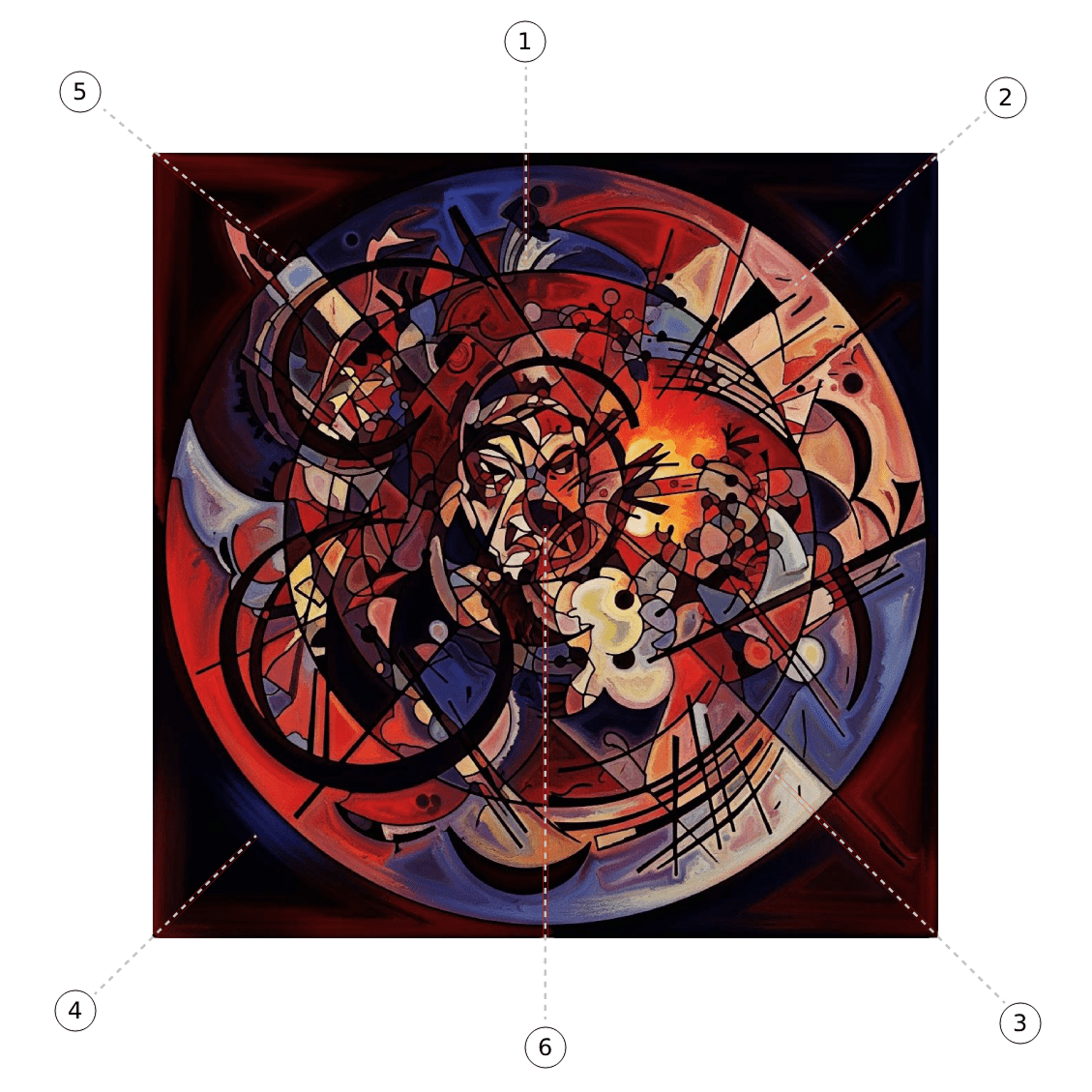
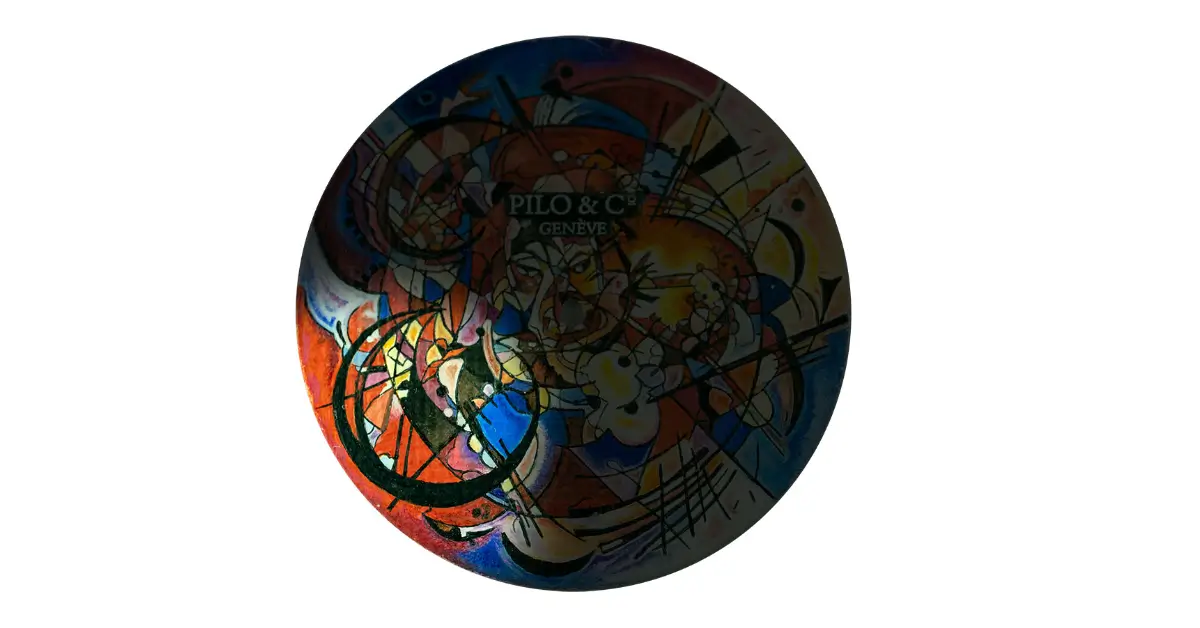
4th segment (From 6h to 9h)
If the previous stages explored tension and encirclement, the fourth episode of the dial introduces a major semantic rupture through the use of contrasting forms. This visual space is structured around the encounter between Raskolnikov’s residual chaos and Sonia’s sacrificial purity. The aesthetic approach here abandons rigidity to explore fluidity and depth, in line with Kandinsky’s research into the spiritual properties of organic forms.
The collision of formal repertoires
In this segment, one observes a juxtaposition of two distinct graphic languages. On the one hand, jagged residual forms inherited from crime and paranoia occupy the periphery of the segment. On the other, circular and organic forms—softer in nature—begin to insert themselves
into the composition.
This coexistence translates the awakening of conscience. Organic forms act as agents of transformation; they are not yet dominant, but they introduce a “breath” into a space that was previously suffocating. The Kandinskian point, once striking like a wound, becomes here a nucleus of condensation—an embryo of moral renewal that begins to stabilize the turmoil of broken lines.
Transparency and superimposition: clarity within shadow
Color treatment in this fourth phase rests on the concept of translucency. The painter no longer relies solely on opaque planes but plays with glazes and superimpositions:
- The emergence of celestial blue and white: These hues, symbolizing spirituality and nascent redemption in Kandinsky’s thought, overlay the blacks and dulled reds of earlier segments.
- The golden glow: Subtle touches of orange-yellow, devoid of the aggressiveness of pure yellow, evoke Sonia’s presence. This color is not applied; it seems to irradiate from within dark forms, illustrating hope rising from the depths of despair.
The rhythm of compassion
The rhythm of the composition changes radically. The jerky agitation of paranoia gives way to a slower oscillation. Forces are no longer directed outward to assault space but fold inward, in a movement of salvific introspection.
In conclusion, this fourth segment of the dial effects a transition from a physics of violence to a metaphysics of grace. Through the play of transparencies and the shift from angle to curve, the work captures the fragile moment when the criminal begins to perceive, through Sonia’s figure, the possibility of another reality. Horological time here becomes the echo of spiritual time—the first glimmer in the night of the soul.