1st segment (Midday/Midnight)
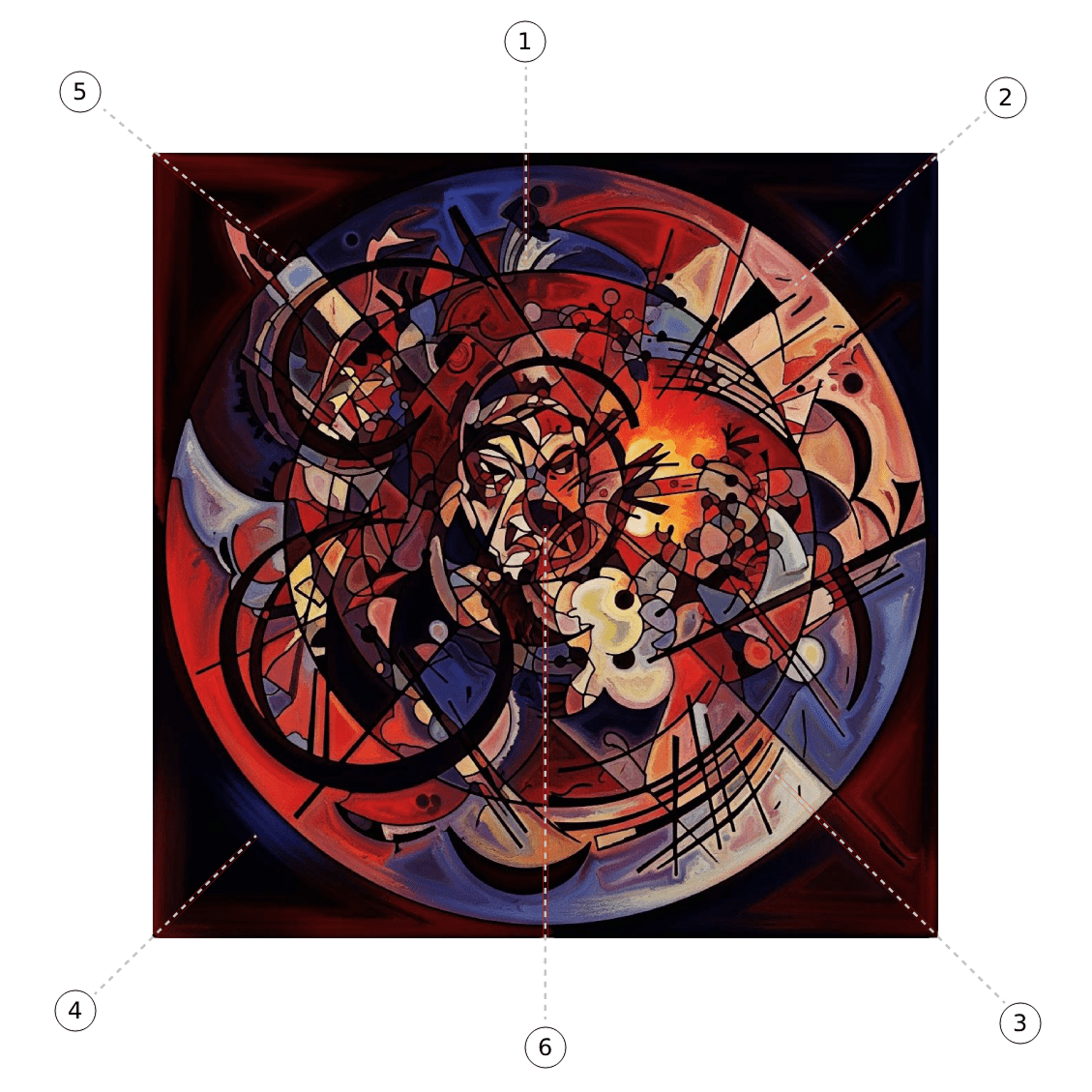
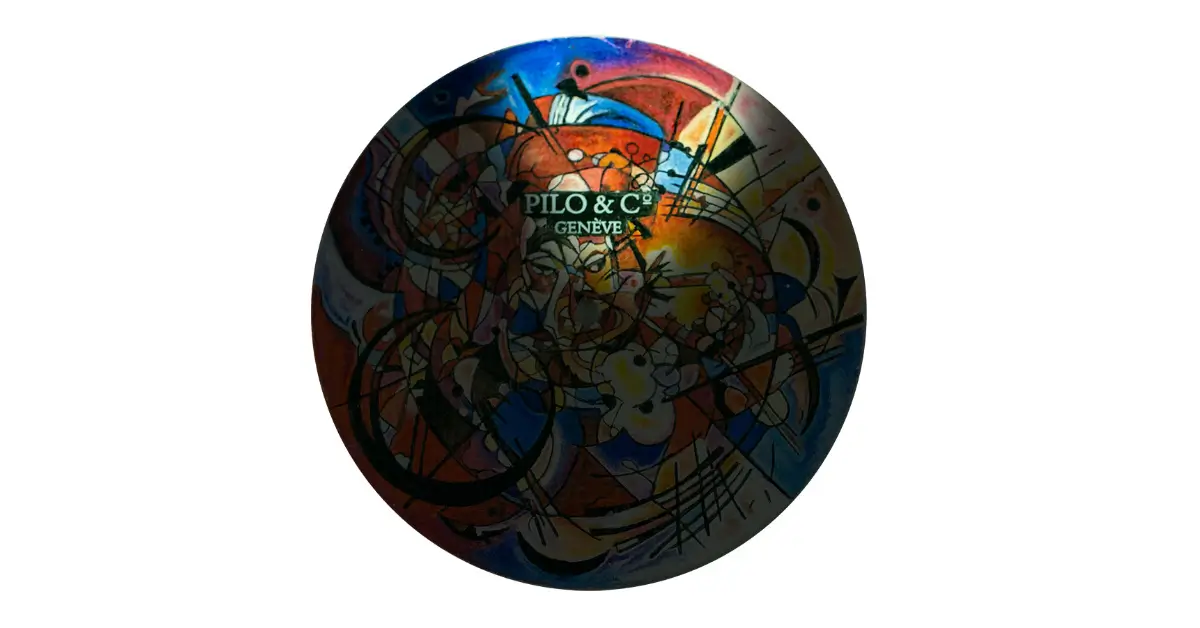
The first segment of the dial, devoted to the founding act of Crime and Punishment, cannot be apprehended as a mere narrative illustration. It constitutes a plastic translation in which Raskolnikov’s moral rupture is transposed according to the precepts of Kandinsky’s “innernecessity.” The following analysis seeks to elucidate the formal and chromatic choices that govern this evocation of transgression.
The geometry of conflict: from line to angle
In Kandinskian aesthetics, the line is the result of a force applied to a point. To represent the axe, the choice fell upon a predominance of broken lines with acute angles. Unlike the curve, which evokes fluidity and harmony, the acute angle possesses a sharp, almost aggressive vibratory
frequency. These triangular, jagged forms do more than symbolize the murder weapon; they embody the penetration of ideology (the theory of the extraordinary man) into organic reality. The geometric structure of the segment creates maximal visual tension: cutting straight lines lacerate the pictorial space, thus marking the irreversible passage from abstract thought to material action. The axe here functions as a vectorial force that shatters temporal continuity and inaugurates the era of rupture.
Chromatic dissonance: a dialectic of blood
The treatment of color in this first episode responds to a desire to express ontological imbalance. Red, the central element of the composition, is not used as a figurative attribute of blood but as a tonal power. According to Kandinsky’s writings, red can signify immense energy; yet when confronted with deep blacks or cold greys, it generates a sensation of spiritual unease.
The palette favors a confrontation between:
– Vermilion red, strident and pulsional, evoking the irruption of violence.
– Black and dark tones, representing the nihilistic abyss and the weight of decision.
The absence of intermediate nuances underscores the radical nature of the gesture. Blood is expressed through saturated chromatic stains that overflow the geometric frameworks, illustrating the impossibility for the protagonist to contain his act within the limits of purely rational calculation.
The organization of space: the rupture of equilibrium
The composition of this starting point on the dial avoids any reassuring symmetry. Space is organized around an off-center gravitational core, creating a dynamic of fall or tipping. The interpenetration of sharp forms and dark masses suggests an atmosphere of psychological
suffocation.
In conclusion, this first episode of the dial does more than situate the action; it establishes the foundations of a visual hermeneutics. Through the use of lyrical abstraction, murder is elevated to the status of a metaphysical phenomenon. The rigor of line and the violence of pigment work in concert to offer a synesthetic reading of Raskolnikov’s original fault, transforming the horological object into a vehicle for philosophical reflection.